
One of the first things a piano student needs to learn is what is the piano keyboard all about? In this brief tutorial you will learn the names of the white keys, the difference between half steps and whole steps and the C scale.
Let’s get started!
The Piano Keyboard

When sitting at the piano you can see the piano keyboard that has a number of white keys and black keys. The black keys are arranged in a particular order. The black keys are grouped in pairs and threes as seen in the image above.
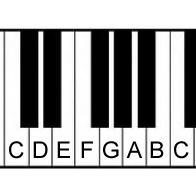
Fig 1: Names of white keys
White Key Names
While sitting at your piano, locate a white key that is to the left of a pair of two black keys. You can see there are several white keys up and down the keyboard that are to the left of a pair of black keys. All of these keys have the name of the letter C.
Find a C close to the center of the keyboard and place your right pointer finger on it and press down to hear the sound. Move your finger to the next white key to the right of C. This key is called D. Press down to hear the sound of this key. Moving to the right is also called moving up the keyboard because the sound gets higher in pitch as your ears will tell you. The key to the right of C is called D. Continue moving to the right and you will find the keys E, F, G, A, and B. After B the key names repeat from C.
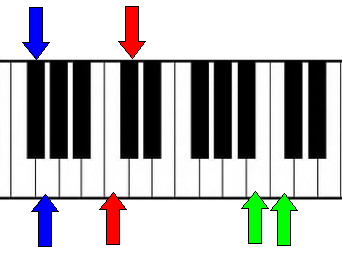
Fig 2: Half Steps on a piano keyboard
Piano Keyboard Half Steps
The distance between keys on the piano keyboard are named either half step or whole step. So how to tell a half step from a whole step? In determining the distance between notes you use all of the notes both white and black.
Locate a C note on your keyboard and then find the closest key to the right whether it’s black or white. As you can see in the image the red arrows show the C note and the nearest note to the right is a black note. This is call a half step. The Blue Arrows show a different half step between a white and black note. The green arrows show a half step between two white keys.
In short, a half step is always the distance between keys that are next to each other whether they are white or black.
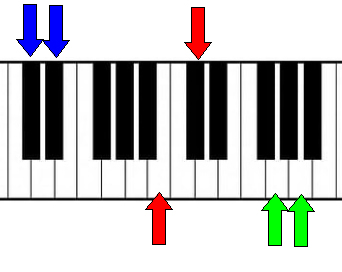
Fig 3: Whole Steps on a piano keyboard
Piano Keyboard Whole Steps
The whole step between keys is determined by locating a key and then skip a key whether black or white, and land on the next key. This defines a whole step.
Look at the image here. A whole step can occur between black keys shown in blue, between a black key and a white key as shown in red, and between two white keys as shown in green. Two half steps equals a whole step on the keyboard.
Fig 4: C Major Scale
The C Major Scale
In music a scale is a series of notes played in.a particular order. In this example you will learn the C Major scale.
Place your finger on a C key and play it. Move your finger to the right and play the D key. Continue playing the E, F, G, A, B, and the final C.
Pay attention to the steps between the different keys.
C – D : Whole Step
D – E : Whole Step
E – F : Half Step
F – G : Whole Step
G – A : Whole Step
A – B : Whole Step
B – C : Half Step
You have just learned the C Major scale and also the secret to playing a Major scale of any of the other keys.
Start on any key: play a whole step, whole step, half step, whole step, whole step, whole step, and finish with a half step.